Single-phase
three-wire submersible motors require the use of control boxes. Operation of
motors without control boxes or with incorrect boxes can result in motor
failure and voids warranty.
Control
boxes contain starting capacitors, a starting relay, and, in some sizes,
overload protectors, running capacitors and contactors.
Ratings
through 1 hp may use either a Franklin Electric
solid state
QD or a potential (voltage) type starting relay,
while
larger ratings use potential relays.
QD solid state Relay
There are
two elements in the relay: a reed switch and a triac. The reed switch consists
of two tiny rectangular blade-type contacts, which bend under magnetic flux. It
is hermetically sealed in glass and is located within a coil, which conducts
line current. When power is supplied to the control box, the main winding
current passing through the coil immediately closes the reed switch contacts. This
turns on the triac, which supplies voltage to the start winding, thus starting
the motor.
Once the
motor is started, the operation of the QD relay is an interaction between the
triac, the reed switch and
the motor
windings. The solid state switch senses motor speed through the changing phase
relationship between start winding current and line current. As the motor
approaches running speed, the phase angle between the start current and the
line current becomes nearly in phase. At this point, the reed switch contacts
open, turning off the triac. This removes voltage from the start winding and
the motor continues to run on the main winding only. With the reed switch
contacts open and the triac turned off, the QD relay is ready for the next
starting cycle.
CAUTION: The control box and motor
are two pieces of one assembly. Be certain that the control box and motor hp
and voltage match. Since a motor is designed to operate with a control box from
the same manufacturer, we can promise warranty coverage only when a
Ohmmeter Test
QD,
A. START CAPACITOR
AND RUN CAPACITOR IF
APPLICABLE (CRC)
1. Meter Setting: R x 1,000.
2. Connections: Capacitor terminals.
3. Correct meter reading: Pointer should swing toward zero, then back to infinity.
B. Q.D. (BLUE) RELAY
Step 1. Triac Test
1. Meter setting: R x 1,000.
2. Connections: Cap and B terminal.
3. Correct meter reading: Infinity for all models.
Step 2. Coil Test
1. Meter Setting: R x 1.
2. Connections: L1 and B.
3. Correct meter reading: Zero ohms for all models.
CAUTION: The tests in this manual for components such
as capacitors, relays, and QD switches should be regarded as
indicative and not as conclusive. For example, a
capacitor may test good (not open, not shorted) but may have lost some
of its capacitance and may no longer be able to
perform its function.
Checking and Repairing Procedures
(Power On)
A: VOLTAGE MEASUREMENTS
Step 1. Motor Off
1. Measure voltage at L1 and L2 of pressure switch
or line contactor.
2. Voltage
motor rating.
Step 2. Motor Running
1. Measure voltage at load side of pressure switch
or line contactor with pump running.
2. Voltage
for slight dip on starting. Excessive voltage
drop can be caused by loose connections, bad
contacts, ground faults, or inadequate
power supply.
3. Relay chatter is caused by low voltage or
ground faults.
B. CURRENT (AMP) MEASUREMENTS
1. Measure current on all motor leads.
2. Amp
3. Relay or switch failures will cause red lead current to remain high and overload tripping.
4. Open run capacitor(s) will cause amps to be higher than normal in the black and yellow motor leads and lower than normal in the red motor lead.
5. A bound pump will cause locked rotor amps and overloading tripping.
6. Low amps may be caused by pump running at shutoff, worn pump, or stripped splines.
7. Failed start capacitor or open switch/relay are indicated if the red lead current is not
momentarily high at starting.
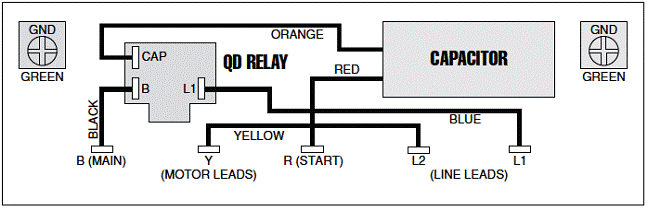
1/3 - 1 hp QD RELAY 280 10_ 4915 Sixth digit depends on hp
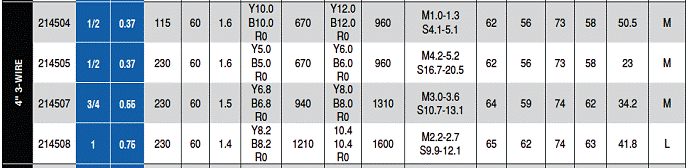
Table 13 Single-Phase Motor Specifications (60 Hz) 3450 rpm

(1)
Start winding - yellow to red
(2) Y = Yellow lead - line amps
B = Black lead - main winding amps
R = Red lead - start or auxiliary winding amps
(3) Control Boxes date coded 02C and older have 35
MFD run capacitors. Current values should be Y14.0 @ FL and Y17.0 @ Max
Load.
B12.2
B14.5 R4.7 R4.5
(4) Control Boxes date coded 01M and older have 60
MFD run capacitors and the current values on a 4" motor will be Y23.0
@ FL - Y27.5 @ Max Load.
B19.1 B23.2
R8.0 R7.8
(5) Control Boxes date coded 01M and older have 60
MFD run capacitors and the current values on a 6" motor will be Y23.0
@ FL -Y27.5 @ Max Load.
B18.2 B23.2
R8.0 R7.8
Performance is typical, not guaranteed, at specified
voltages and specified capacitor values. Performance at voltage ratings not
shown is similar, except amps vary inversely with voltage.